

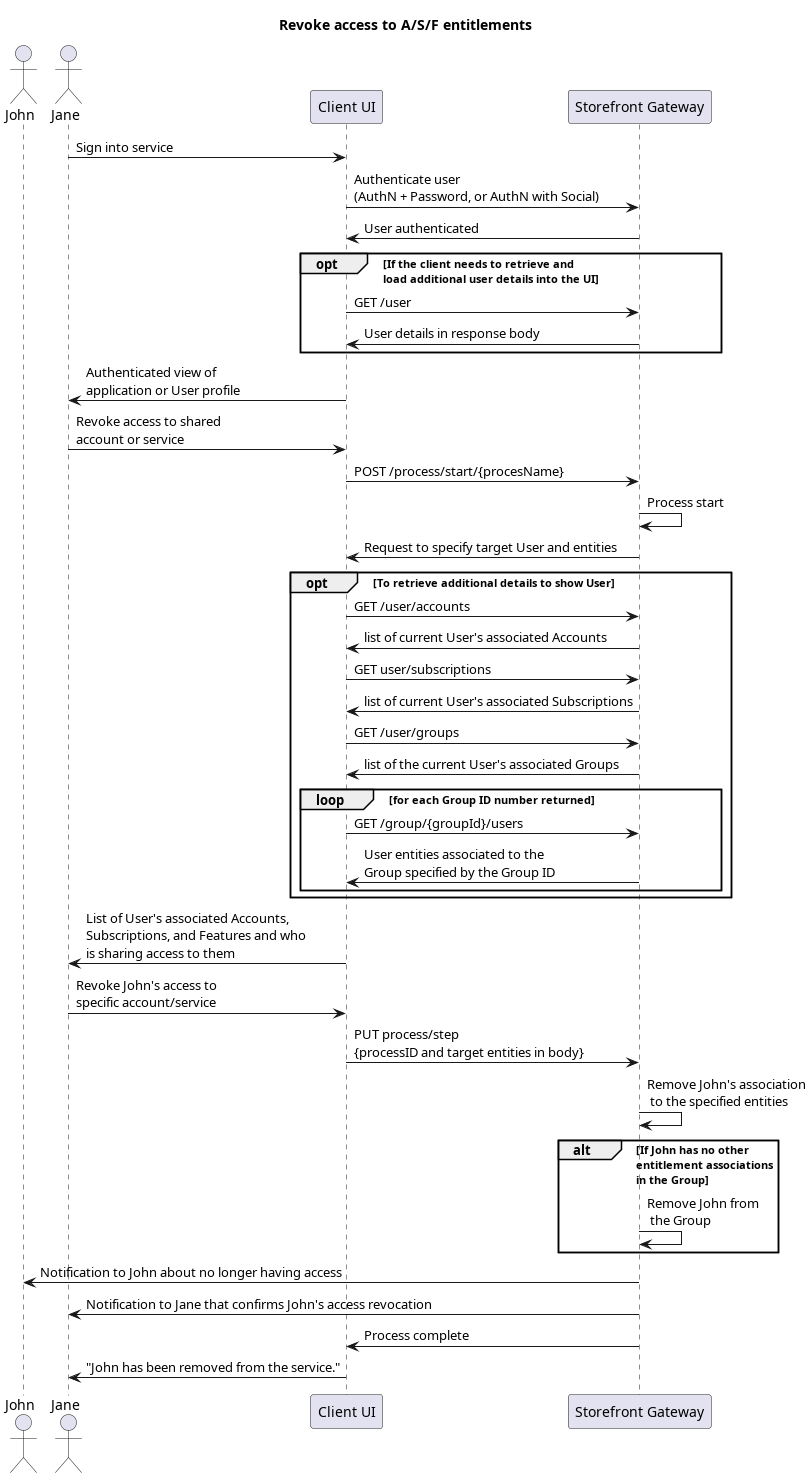
Initial Request
Your client calls the Process Start API to initialize the Process:Response: Specify Targets
Storefront Gateway responds with a prompt to specify the Account, Subscription, or Feature entitlement entity, and which User entity to un-associate from the entitlement. The response also includes a list of applicable entity types for the client to specify:id property on each Storefront Gateway entity. As this number is likely not known to the user, the client application should leverage the relevant APIs (e.g., GET /user/groups API, or GET /group/{groupid}/users), in conjunction with this Process, to retrieve additional details stored on each entity, and then render them to the user (e.g., to display each possible target user by their firstName and each possible entity by their displayName).
Note: The parameters object indicates what it needs from the client to continue its task. In this scenario, the values for each field in the object are generic and indicative of format (strings and integers), but not the specific exact values expected in the next request. In other words, the client should ignore the any sample values (e.g., “1” account, “12345,”) in this response, and instead simply return the user’s selections (the target Storefront Gateway User entity, specified by the id property and the entities to remove from that User, specified by their entity type and unique id property.).
Final Request: User Selections
Your client passes the user’s explicit selections to the Process using the Process Step API:entities array. For example:
Process Complete
Storefront Gateway removes the entitlement entity associations in order to revoke the target end user’s access to the shared account/service(s). The Process returns anHTTP 200 status: